-

Researchers from UConn and Yale have developed a new solar-powered water disinfection system that combines several existing methods

-
UConn Marine Sciences Associate Professor Samantha Siedlecki co-leads a data-driven project to predict the growth of scallops across vast geographic regions and more than a century of time
-
The UConn-led NERR will apply the funds to significant improvements at the popular park, supporting habitat and restoration
-
Backed by a grant from the NSF, WISER was established in 2023 to apply the research and expertise at UAlbany and UConn to solve challenges related to energy systems



 UConn Gives, the annual 36-hour fundraising event at UConn, will be taking place on April 21 and 22. Every year, the UConn community rallies to support many different causes on campus, including our own Campus Sustainability Fund and the UConn@COP Fund!
The Campus Sustainability Fund (CSF) finances programs and initiatives that support students and advance UConn’s position as a global leader in university sustainability. Contributions to the CSF provide critical funding of transformative learning experiences for students including hands-on professional development through internships and research projects that nurture our natural environments, improve health and wellbeing, and enhance environmental justice in the communities which we serve. The CSF also funds our experiential learning events such as the Haunted HEEP, the UConn-famous annual haunted trail walk at the Hillside Environmental Education Park.
The UConn@COP Fund supports the UConn@COP Fellowship program, helping the OS send a cohort of students each year to the annual United Nations Conference of the Parties. Through UConn@COP, students have participated in panels at international press conferences, networked with global environmental leaders, and heard from and interacted with international delegates and core members of international environmental justice movements. UConn@COP is an incredible, transformative experience for fellows, and it would not be possible without the support of generous donors!
Every donation, big or small, means so much! Thank you to everyone for supporting sustainability achievements and the environmental leaders of tomorrow!
Attention UConn Faculty and Staff Members:
The steering committee for the UConn@COP Fellowship Program is pleased to extend a call for expressions of interest by UConn faculty and staff members who are interested in joining the UConn@COP31 contingent as it travels to Antalya, Turkey from November 14-21, 2025 to attend the United Nations Conference of the Parties (UN COP31) climate change conference.
Critically, participation in the formal Fellowship Program and travel with the group require all travel expenses, including flight and hotel fees be self-funded.
Due to space limitations, only two faculty and staff members will be able to stay with the group as part of the official delegation. Nonetheless, anyone already planning to attend the conference is more than welcome to meet with the UConn delegation in Turkey.
Please note, conference passes are scarce and not guaranteed. Priority for passes will be given to students before faculty or staff members. We encourage applicants to seek alternative sources for obtaining an official UN conference badge.
Opportunities to contribute to the program include:
- Leading topic-specific “breakfast club” conversations in the mornings at the conference with the UConn@COP fellows
- Participating in group cultural immersion excursions
- Leading or participating in pre-travel educational meetings
- Participating in the Climate Change Café and Symposium on December 2, 2026 from 4-6pm in the Student Union.
To submit your expression of interest, please email the UConn@COP steering committee at sustainability@uconn.edu by 11:59pm on May 10th. Please be sure to address the following questions in your email:
- What contributions to the UConn@COP Fellowship Program might you offer the students?
- What will you gain professionally by joining the UConn delegation attending COP31?
Please feel free to email the UConn@COP Fellowship Program steering committee with any questions, at: sustainability@uconn.edu
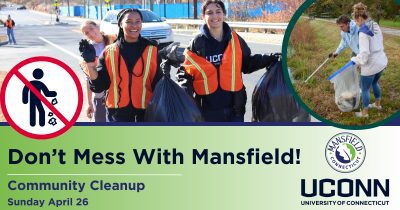
The Town of Mansfield and UConn are pleased to team up against litter in our town. Join in to meet others in the Mansfield community and do good for our people and planet.
| UConn & Vicinity | Town Wide | |
| Date & Time: | Sunday, April 26
Cleanup Check In Stations will be open Noon to 4pm Optional RSVP HERE. |
Sunday, April 26
At your leisure throughout the day. OR Noon to 4pm to participate with UConn students. |
| Where: | Volunteer to clean up in the core of campus, Hunting Lodge Rd, Separatist Rd, North Eagleville Rd, Moulton Rd, or Eastwood/Westwood Rds.
Litter pickup supplies will be provided at check in stations. |
This year UConn welcomes all residents to join students in cleaning up North Eagleville Rd. Park in F Lot and check in at the litter clean up station near Wings Over Storrs. Bags, gloves and safety vests will be provided.
On your own? You’re welcome to go anywhere you feel safe collecting roadside litter. Roads that are especially littered include Browns Rd, Chaffeeville Rd, Maple Rd, Pleasant Valley Rd, Mansfield City Rd, Moulton Rd, Stearns Rd, White Oak Rd and Gurleyville Rd. Consider making a commitment to pick up litter on a section of road throughout the year by joining Adopt A Road. |
| What To Do With Full Trash/Recycling Bags: | Bring your litter bag to your Check In station once you are finished. Casella trucks will be making rounds to pick up bags from the stations. | Bags of litter from independent clean ups may be placed out with household trash for those with collection service or taken to the Mansfield Transfer Station for no charge. The Transfer Station is located on Rte 89, one mile from the intersection of Routes 195 and 89 in Mansfield Center at 221 Warrenville Rd. The Transfer Station is open Tuesdays, 8:30 am to 4:00 pm, Thursdays, 12:00 pm to 4:00 pm and Saturdays, 8:30 am to 4:00 pm.
If you’re joining UConn, bring your bag back to the litter station at Wings Over Storrs. |
Litter is an unsightly blight on our roadways, and hurts the environment. It can be especially dangerous for wildlife. Small animals may crawl into bottles and get stuck, and litter can blow into storm drains and streams and may eventually make its way to the ocean. When litter gets eaten by animals and sea life, they can starve to death or suffocate. Litter also attracts pests. Be part of the solution, not the pollution!
Since starting this program in 2024, we have collected over 3,684 pounds of litter!
Read last spring’s story about Don’t Mess with Mansfield in UConn Today.
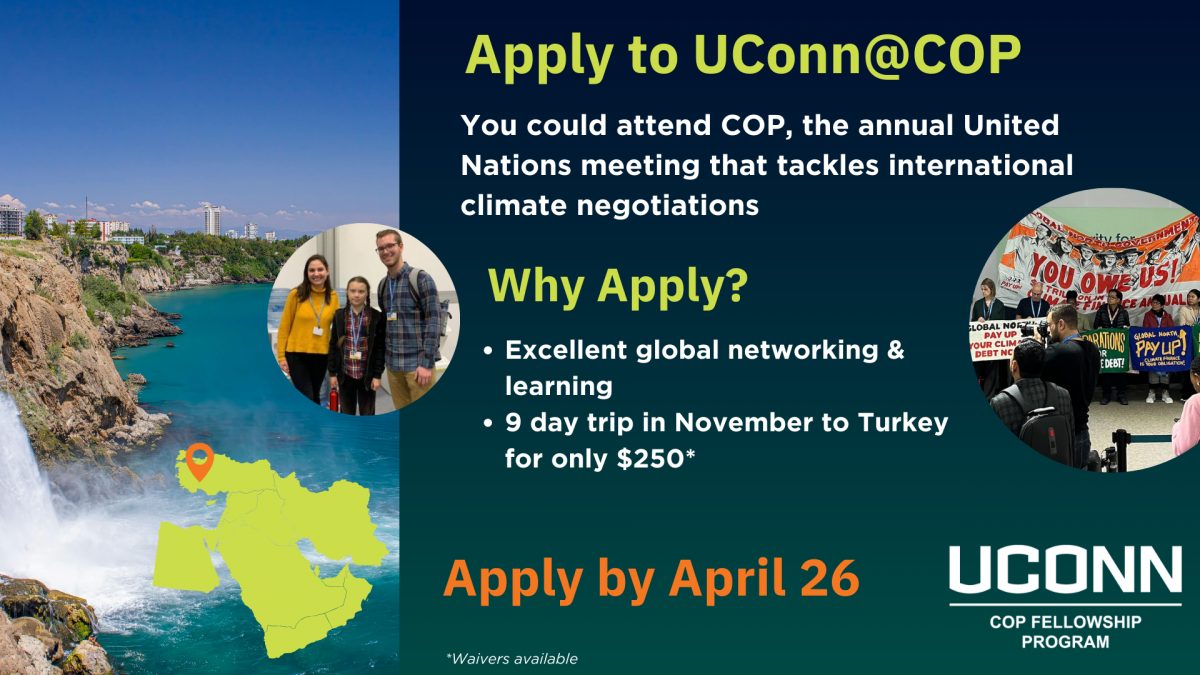
Applications for the UConn@COP Fellowship Program are now OPEN! Attend the United Nations’ global climate negotiations – the Conference of the Parties (COP) in Belém, Brazil from November 14-21, 2026.
COP brings together diplomats, business executives, heads of government, university leaders, environmental activists, NGO’s and other delegates to discuss progress in dealing with climate change. Through this program, UConn students have participated on panels at international press conferences, networked with global NGO’s, environmentally-minded businesses & renewable energy companies, engaged in immersive art exhibitions, attended film screenings put on by the directors themselves, interacted with international delegates & core members of environmental justice movements, and connected with like-minded, passionate students at other colleges & universities in the U.S. and around the world.
The UConn@COP program funds nearly all travel and registration costs thanks to generous donors. Fellows are responsible for $250, but can request a waiver in the event of hardship.
Apply by April 26, 2026 at 11:59pm. No late applications are accepted.
You Complete: COP Application Form
The application asks for student leadership experience, academic information and a short answer to:
In what way(s) do you see yourself contributing to UConn@COP’s efforts to enhance diversity, equity, and inclusion in the program and more generally addressing Environmental Justice. (250 words or less)
You’ll also attach:
- A one-page PDF of your current resume
- A photocopy of your passport (or copy of your passport application confirmation receipt)
- One approximately 700-word essay responding to the following prompts:
-
- Describe what relevant academic, leadership, and personal experiences make you an ideal candidate for the UConn@COP30 Fellowship Program.
- If selected, how will you share your experiences from UConn@COP with the UConn community? (your plans for outreach should be both aspirational and achievable)
- How will the components of the conference and Fellowship program overall benefit your future career?
Your References Complete: In order to be considered for the UConn@COP program, you need two references (one must be from a UConn Faculty Member) to fill out the recommendation form linked below. Please share this link with your references and have them complete it by the application deadline, Wednesday April 26 at 11:59 PM. UConn@COP Reference Form
Selected Fellows are notified by August 1st.
If you have an interest in climate action, apply! Details on the program and application information can be found HERE.